


















Exam week at Homewood High School looks different this year with final assessments shifting focus to student growth and ditching the traditional, cumulative exam.
For the past few years, final assessments accounted for 10 percent of a student’s final semester grade. However, that was not substantial enough in the grade book. Students needing to raise their grade often couldn’t do so with a 10 percent exam, and equally, the exams offered very little penalty for bombing the test.
Now, students with As in regular classes do not have to take a final, while students with Bs will have the option to take one to improve their grade. Students with Cs, Ds and Fs are required to take the final assessments for regular courses.
In addition, a diverse student body has different needs in terms of education, an aspect where traditional exams fail to support students. HHS assistant principal Jana Flinkow played a crucial role developing the final assessment opportunity decisions along with the board and Dr. Henneke.
“This really is allowing teachers to look at students individually and not as a collective group, because what you need may not be what this student needs,” Flinkow said. “And what you need to show growth and mastery of is not something necessarily your whole class does.”
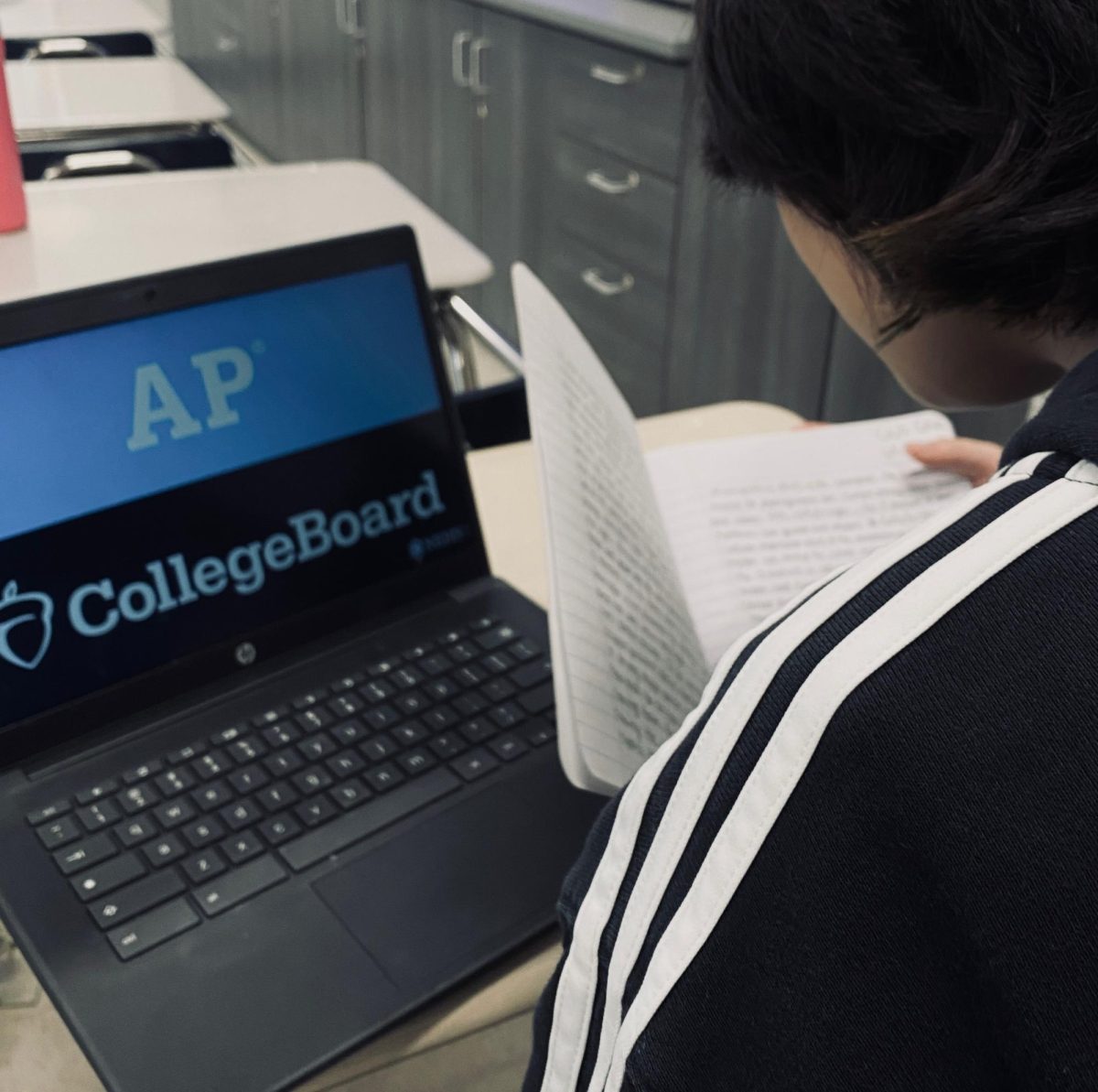
AP and honors classes have different systems because those classes imitate college courses.
“They can have full summative exams that count as a separate grade, and the reason for that is because that mimics college, and it’s a college level course,” Flinkow said.
Senior Titus Smith, who takes eight AP classes, said the new exam format doesn’t feel significantly different for him.
“A lot of my teachers already did it like that, where the exam would replace the lowest test grade, so it’s not a huge change,” Smith said.
Some teachers are ruling out exams and replacing them with assignments.
“For a couple of my classes, it is not really an exam anymore, like you’re coming in and doing a few assignments to replace others things I’ve already passed,” Smith said.
The lack of clarification confuses students, especially those taking honors and AP courses.
“It would be nice to have more clarification since I have all AP classes,” Smith said.
Junior Isabella McCoy participates in Color Guard and takes three APs. She expresses frustration on how teachers are required to give students loads of work for retakes, an especially difficult time for junior year, widely seen as the most pivotal year in a student’s academic journey.
“When it comes to [teachers] trying to make the final assessment opportunity test, it leads to more busy work, because I’m getting more loads of homework and classwork that we aren’t doing, but making us do for the final assessment opportunity test,” McCoy said.
There’s still some discrepancy in what people in the school are calling the new exams. Many have adopted FLO, for final learning opportunity, but Flinkow prefers using “assessment” in the acronym.
“I don’t like calling it FLO, I think that’s gotten a little confusing,” Flinkow said. “I would call FLO a future assessment opportunity which is throughout the course of the semester. I would say this is a final assessment opportunity…to be able to show growth and mastery.”
Exam week at Homewood High School looks different this year with final assessments shifting focus to student growth and ditching the traditional, cumulative exam.
The concept is one of continual learning where poor performance on earlier assessments should not hurt a student’s grade if that student now knows the content much better.
“The final assessment should be your opportunity to show your teachers, ‘I’ve actually learned this, I can go back and show a higher level of mastery than what I did at the beginning’,” Flinkow said. “You don’t need to retake something you have already shown mastery of, but if you didn’t show mastery of it, you do need an opportunity to show it.”
Because of that, Flinkow said students’ grades cannot go down because of their final assessment opportunity.
“We want students to have the mindset that this is an opportunity where I can show growth, ‘my learning did not stop in October, because that’s when I took the test,’” Flinkow said. “It goes on.”
In order to make a final decision, HHS examined a diversity of school policies.
“We looked at several different high schools across the nation that do exams differently, and looked at what they do, what can we learn from them, what can we take from them, but also what do we need to make our own?” Flinkow said.
Although no direct student input informed the changes, she added that the school listened to student exam complaints last year, leading to conversations about a change.
“In the spring of last year, students expressed clearly their hate for exams, how it’s not helping them, and the stress it’s bringing on to the student, with the outcome not being worth the stress” Flinkow said.