














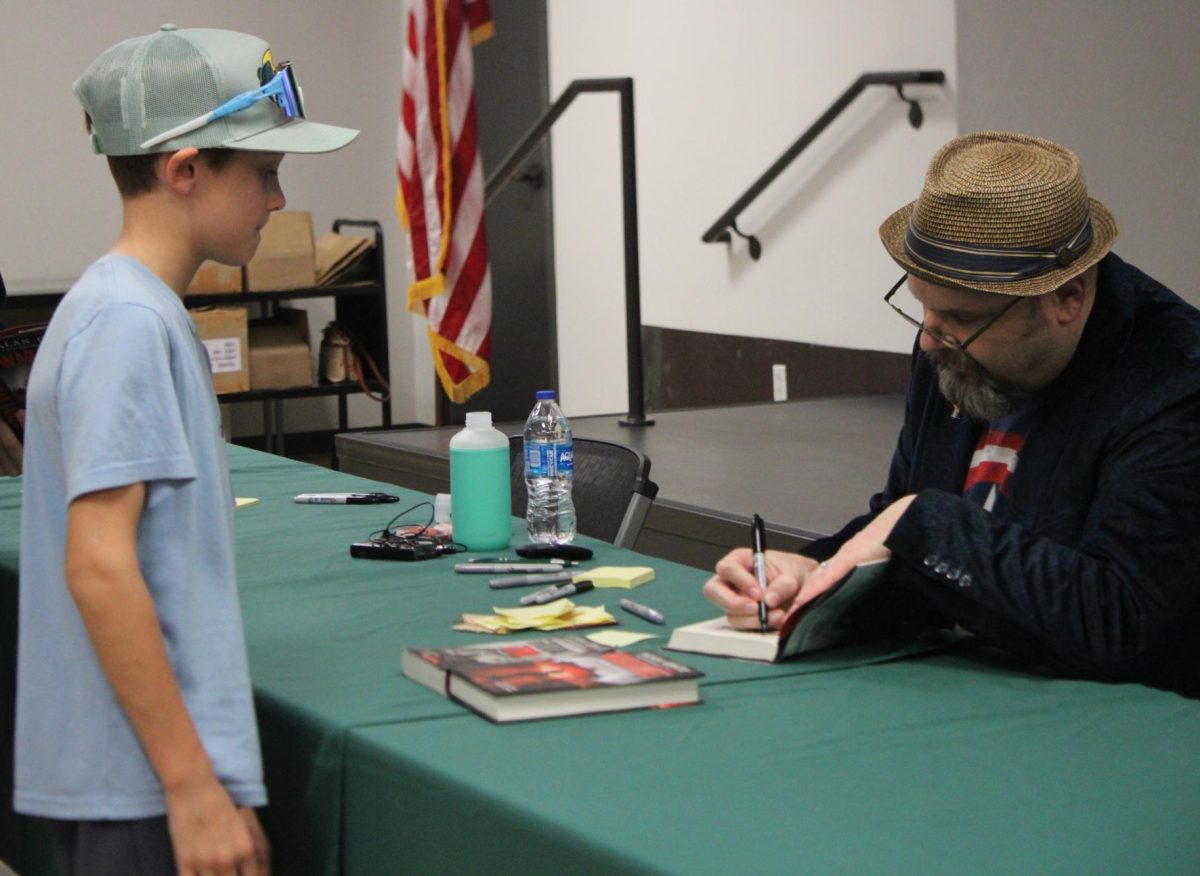
New York Times bestselling author Alan Gratz visited Homewood Public Library Nov. 8 for a book signing event to promote his latest novel “War Games.” Gratz delivered a 45-minute presentation detailing the inspiration behind critically acclaimed works like “Refugee” and “Projekt 1065”, followed by a brief audience Q&A.
Gratz’s book tour for “War Games” spanned 11 U.S. cities over the course of October, with notable stops in New York, New Orleans and Austin. Set during the 1936 Berlin Olympics, the thriller follows 13-year-old Evie Harris as she trades leotards for larceny in a plot to steal Nazi gold.
Gratz writes about major historical events to help his younger audiences understand them. He has published over 20 books and graphic novels, with “War Games” rising to bestseller status on lists from USA Today and Publishers Weekly.
“I’m looking at events that kids are curious about,” Gratz explained. “Kids books get right to it; they don’t beat around the bush, they don’t take 100 pages to start the story…My job is to write books that grab kids right away, and that’s what appeals to me about books for this age.”
Gratz focuses his stories through the eyes of kids who played a role in the event. While the B-52 bombers or the Battle of Midway are action packed, the air and naval battles lack a youth perspective.
“I’m always looking at ‘Were there kids there?” Gratz said. “‘Were they involved enough in the event for me to tell the exciting part?’ I don’t want a kid to just watch something.”
The Homewood Public Library Foundation is a volunteer organization that raises money to make these author visits possible. Incoming president Rebecca Smith is a fourth grade teacher at Shades Cahaba who incorporates Gratz’s books in her classroom.
“I’ve read 12 of his books,” Smith said. “I love that he talks about social issues in really accessible ways for kids and teens to read about. Every chapter is like a cliffhanger ending, so that keeps you going.”
Gratz shared advice for young aspiring writers during his book presentation, advice that Smith finds valuable for future lessons.
“As a teacher, I loved the idea of an ‘idea notebook’ for kids to keep,” she said. “And just being able to spread his love of these books, I think that’s huge.”
195 people from across the Birmingham metropolitan area came to support the Knoxville, Tenn. native. Dozens of families brought books from their home libraries or purchased new editions from Little Professor’s pop up shop.
“To be able, on a Saturday afternoon with all the football that’s on TV, to get that many kids out is astounding,” Gratz said. “So that’s probably my favorite thing: that the library here did such an amazing job of spreading the word about my event.”
Sixth grader William Cornatzer lives in Crestline and brought 11 books to be signed. Alan Gratz is “definitely” his favorite author.
“I’ve been into graphic novels for a while, but when I was in third grade, I picked up ‘Allies’,” Cornatzer said. “I couldn’t get my head out of the books, so then I started reading books without pictures.”
He cites his mom as a major supporter of his reading choices, both in supplying his collection and giving him a World War II history background.
“My family is Polish,” he said. “[When reading] I’m like, ‘Hey! I recognize that!’ because I’ve been there and seen those camps.”
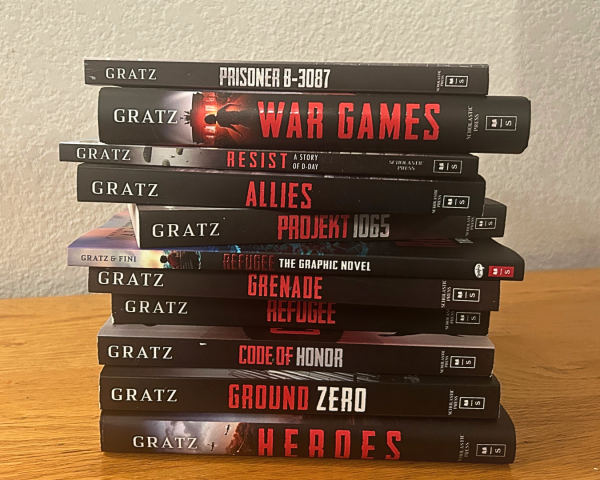
Fans like Cornatzer are Gratz’s core audience given that, for most of the writer’s childhood, he preferred graphic novels to chapter books. He also credits his mother with forcing upon him an appreciation for the classics.
“I remember how hard it was to get me to sit still and read a book,” Gratz said. “So now I’m trying to write the kind of book that I would have sat and read when I was a kid, stories that have high stakes and really relatable characters.”
From chronicling the survival stories of Holocaust survivors to the harrowing journeys of international refugees, the mental load of compiling these stories can take a toll on the author. Reconnecting with friends and family is important for him to stay grounded and positive.
“Every day I’d have to be in my office alone, looking at pictures from the concentration camps, reading people’s experiences…trying to put myself in the shoes of a prisoner,” Gratz said about writing his critically acclaimed novel “Prisoner B-3087.”
He hopes to write about the Hindenburg disaster and the American Revolution. Despite avoiding depressing headlines while drafting, Gratz stays informed about current events to inspire his work.
“AI is a big question for authors now,” Gratz said. “I don’t use it, but it’s being used a lot…When I see stuff that’s in the news now, I often think, ‘How did we get here? What’s the path that we took to get here? And what’s something in the past that relates to this? And can I tell that story and then have the kids and their teachers and parents making those connections outside of the book?”
His dedication to the preservation of history culminates in a message that he hopes readers of all ages will identify with.
“I hope what they take away is some empathy for other people,” Gratz said. “And I hope that they take away some knowledge about the past, and I hope that they see the ways that the past connects to the present and how we got to where we are now.”
Bridging the gap between history and today is no small feat. Although Gratz’s books cover a wide variety of world events, the takeaway remains the same.
“Every time I write a new book, I start with a different theme,” he said. “And every time I finish a book, I keep coming around to the same theme over and over again: We’re stronger when we work together. If I shoot for all those all the time, then I’m going to hit it more times than I miss.”