
















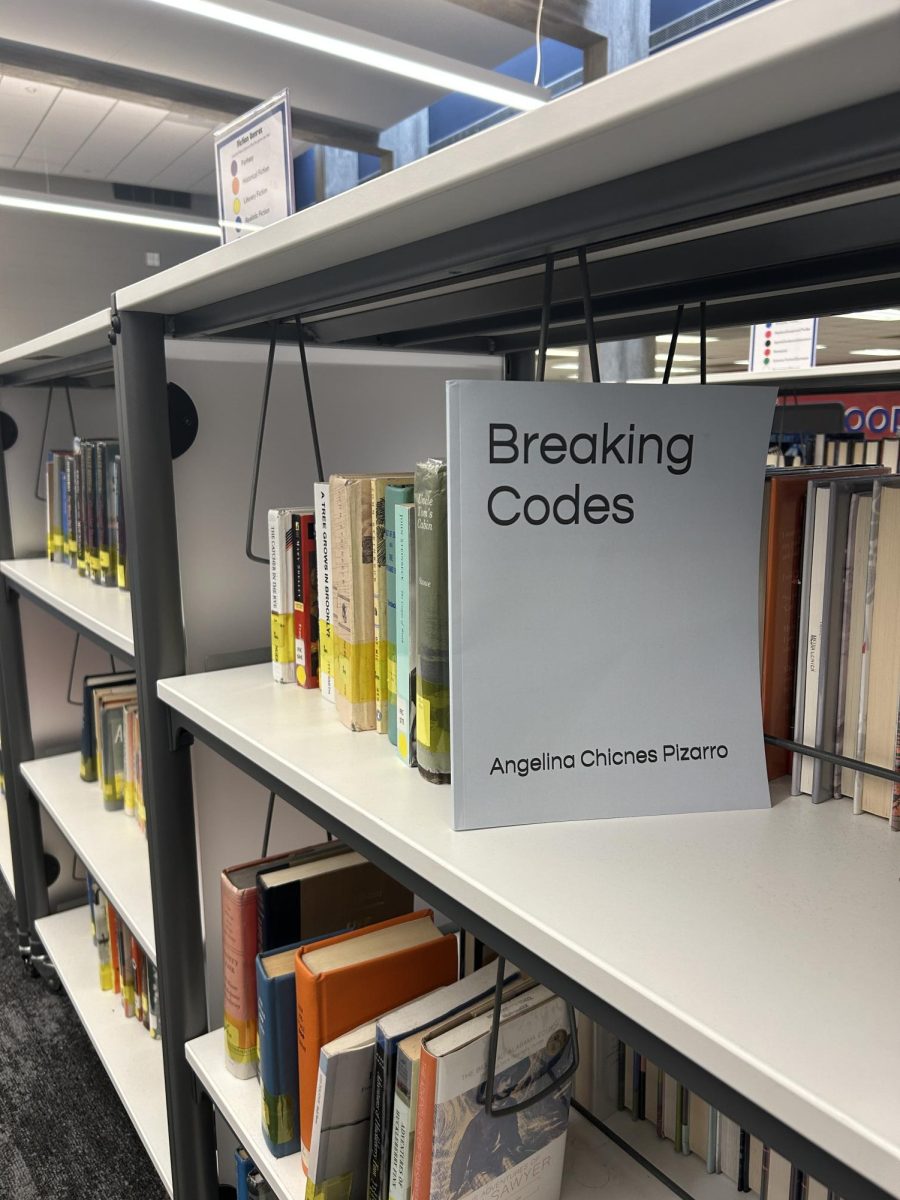
From dream to reality, Angelina Chicnes Pizzaro is celebrating the first publication of her career. Stemming from the disproportionate demographics of computer science, her book titled “Breaking Codes” aims to inspire those who feel underrepresented.
Over time, Pizarro realized she desired more than just good grades. Her book serves as a testament to hard work and dedication.
“I wanted something that would reflect my efforts and the time that I put in, yet something that would also qualify as school,” Pizarro said. “I wanted something that was out there for everyone to see, because not everybody can see my GPA.”
Being Hispanic and female, Pizarro is vastly outnumbered in the field of computer science. Eighty percent of workers in the industry are men, and only 6% of them are Hispanic. With “Breaking Codes”, Pizarro aims to break the boundaries of the skewed demographics.
“For me, I see the boundaries of being Hispanic through people thinking less of my education. But knowledge and education should be equal,” Pizarro said. “From my experiences, I set my eyes on computer science to be equal for all. That’s why the book is very gender and community-friendly.”
In her sophomore computer science class, Pizarro watched a documentary about Grace Hopper, an icon in early computer science who made significant contributions. However, she remains a person most people have never heard of, despite her high achievements. Beth Matthews, Pizarro’s computer science teacher her sophomore year, acknowledges Hopper’s advancements.
“She was a pioneer; a lot of the first computer scientists started as mathematicians, then they would jump fields to computer science, and she was the first woman to really do so,” Matthews said. “One of the main things she was credited with was the development of the bug.”
A bug is an error or defect in code or hardware that causes a system to produce an incorrect result. Her development of the idea of the bug progressed computer science tremendously, yet she remains in the shadows.
Matthews is not the only computer scientist who finds inspiration through Hopper. Pizarro describes the effect her discovery of Hopper had on her.
“I had never heard about her before,” Pizzaro said. “You always hear about somebody like Bill Gates. You hear of rich, fancy men who did great things, but you don’t often hear about women who have similar achievements. That caused me to realize they should have representation, too.”
Pizarro has already received recognition for her writing. Pizarro piqued an interest in the popular Hispanic radio station, La Jefa. They interviewed her for her efforts.
“They were very interested because they like seeing younger generations give effort, especially in times that the Hispanic community is facing a lot with politics and the government,” Pizarro said. “They thought it was very inspirational.”
At points throughout the intricate writing and publishing process, Pizarro found herself frustrated. During those times, she found inspiration in her sister.
“She has always pushed me to do more,” Pizarro said. “I’ve especially been inspired by her leadership and the way that she takes initiative. So, I wanted to do something to show my initiative.”
Her sister was not the only one to inspire her. Matthews was the teacher who empowered her to write.
“She was kind, and she was always trying to help,” Pizarro said. “She definitely inspired me to pursue it. She reinforced the idea that women can be successful and reminded me that I could do it. She was always very encouraging.”
Pizarro’s book aims to encourage and reflects on Pizarro’s own experiences to offer a solution.
“There are no boundaries, mentally or physically, that you can’t overcome if you want to pursue something,” Pizzaro said. “It is all about grit, especially when you fail.”
As one of Pizarro’s primary mentors, Matthews shares many of the same views as Pizarro. Matthews highlights her hopes for the future of women in computer science.
“It’s not just about women being successful, but simply having women in computer science, because it’s a male-dominated field, specifically white male-dominated,” Matthews said. “It’s not just overwhelming, but nerve-racking for women to enter a field that they’re not normally in. So, having success stories shows people they can do it. Even if it’s male-dominated, that doesn’t mean it always has to be.”
For many teachers, seeing their positive impact on a student unfold is the best part of the profession. For Matthews, learning about her influence on Pizarro and her new book was that moment.
“I was thrilled and excited, and I immediately went and ordered the book from Amazon,” Matthews said.
Miyelani Mathebula, HHS junior, took on the role of editing “Breaking Codes”.
“She literally texted me one day and said, ‘Hey, I heard you do editing, and I’m working on a book. Do you want to help me with it?” Mathebula said. “I said sure, I’ve got time.”
At the start of her project, Pizarro was at a loss for who would edit her work. However, finding Mathebula gave her peace of mind.
“She was definitely helpful,” Pizarro said. “She’s so humble and helped in setting it up and making the process go faster. She was always finding new things that I could do and suggesting new ideas that I could work with.”
Pizarro and Mathebula found they had lots in common with each other, especially in the similarities of their backgrounds. Mathebula highlights what made this project so interesting to her.
“I really identified with Angelina and the message of making computer science education more accessible because we’re both children of immigrants,” Mathebula said. “We’re both going to be first-generation college students. So, I think that really created a bond between us, because we both believed in the mission. I think that’s what made our partnership so great.”
With a project that has so many steps, it takes great focus to keep timing along with school and the activities that come with being a teenager. Mathebula recognizes this feat.
“I’m really proud of Angelina, because it takes a lot of work to coordinate a project of this size,” Mathebula said. “I’m really glad that the message can get out because it’s not just for people who are immigrants; It’s also for younger kids who don’t know anything about computer science. Making knowledge more accessible is always great.”
As for the future, Pizarro isn’t quite sure what exactly she’d like to do, but she does have an interest in continuing to write.
“If I feel strong in my writing, I’d want to pursue it more in a future career,” Pizarro said. “I’d like the next book I write to be more of a story.”